

According to 2024 figures from the Real Estate Roundtable, 97% of US business facilities are less than 100,000 square feet. Buildings under 10,000 sq. ft. account for about 49% of buildings and 24% of businesses are between 11,000 and 99,000 square feet.
For the smallest facilities, under 10k sq. ft., a couple of Wi-Fi® access points will do the trick. Need more capacity or coverage? A mesh Wi-Fi network won’t break the bank. On the other hand, buildings over 100k sq. ft. will shell out hundreds of thousands of dollars or more for a traditional active distributed antenna system (DAS) or private 5G network.
But what about the 24% of businesses in the middle, the middleprise. They need more than simple Wi-Fi but can’t afford the cost of an active DAS or private network. What are their options? Truth is, there aren’t many, or weren’t many until a couple of months ago.
In September, SOLiD announced the release of SOLiD BARS™, the enterprise-grade in-building wireless solution that’s specifically designed for middleprise companies.
This press release gives you a good overview of the what, where and why of the SOLiD BARS solution.
The active DAS optimized for the middleprise
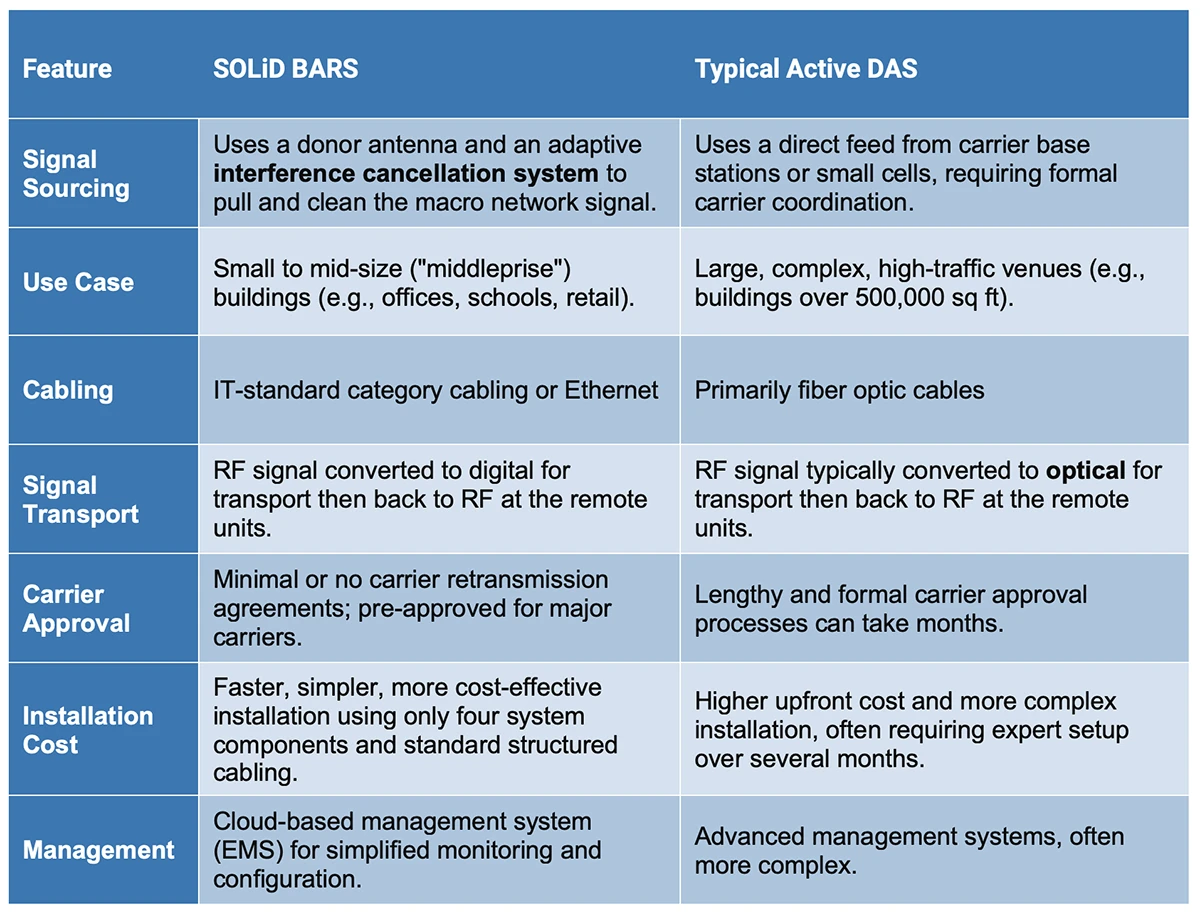
The SOLiD BARS active DAS solution is purpose-designed for small and mid-size facilities. It uses the standard Category or Ethernet cable typically found in most enterprise buildings and requires minimal or no carrier retransmission agreements. Modular components make the BARS solution faster, easier and less costly to install.
In short, the difference between SOLiD BARS and typical active DAS systems is as great as the difference between passive and active DAS.

Checking all the right boxes?
When it comes to the wireless environment, connectivity challenges and user requirements, your business is unique. Finding the right solution fit means checking off as many of the boxes as possible.
To help you start thinking about what those specific boxes are, take a look at our “8 Tips” blog. It addresses some of the most common issues, concerns and misconceptions that middleprise customers have.
Drilling down to the best solution
Hopefully, the 8 Tips blog will help you start thinking about some of the key questions involved in choosing an in-building connectivity solution. Eventually, however, you’ll need to get into the nuts and bolts of the decision: what technology you need, how it will be deployed, the expectations and performance requirements and, of course, the budget.
That’s why we developed the In-Building Cellular Solution Finder. It’s an interactive worksheet that walks you through the process of identifying the characteristics of your ideal solution. It consists of ten questions, mostly multiple-choice, such as your company’s vertical market, the space you need to cover, anticipated number of users, challenges you’re currently having, etc. Simply select the answers that most closely match your environment and needs and receive a free analysis with the best potential solutions based on your answers. Ready?

Putting it all together
By now, you’ve learned a thing or two about the in-building wireless ecosystem, the differences between the SOLiD BARS solution and traditional active DAS platforms, and what to consider when making a decision.
Time to bring everything together. Our SOLiD BARS DAS e-book provides all the information you need to take the next step.
Download the e-book, then let us show you how SOLiD can solve your in-building connectivity challenge. It’s easier than you think. We promise.