
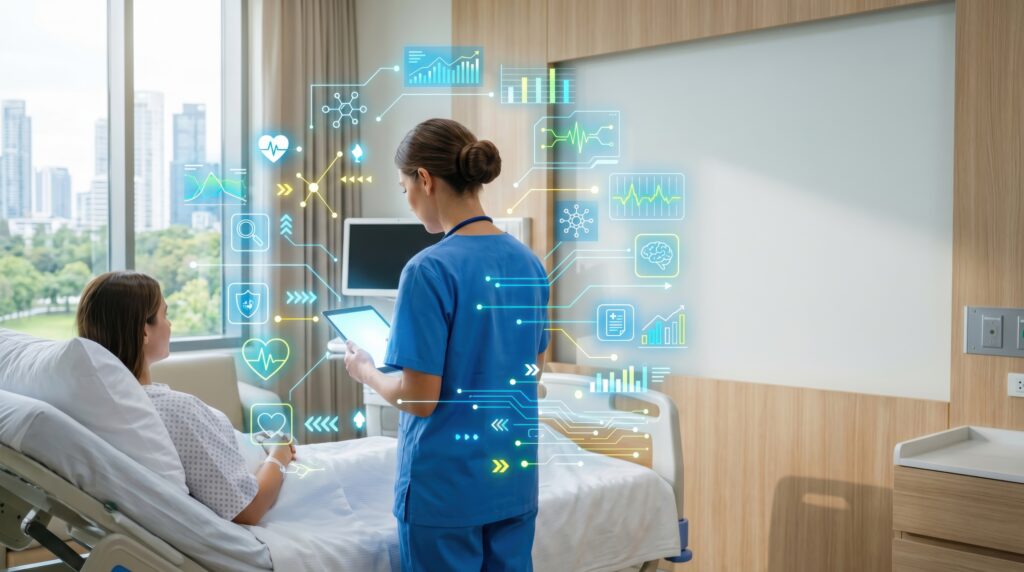
The healthcare landscape is undergoing a monumental shift. As we navigate the complexities of 2026, clinical environments are no longer just physical buildings filled with medical equipment—they have evolved into highly complex, digital ecosystems.
This rapid digital transformation in healthcare isn’t occurring in a vacuum. It coincides with an unprecedented labor crisis. According to the World Health Organization, the global healthcare sector faces a projected shortfall of 10 million health workers by 2030. Today, over 70% of healthcare leaders cite burnout and retention as their most critical operational hurdles, with nursing, primary care, and specialized clinical roles in the shortest supply.
To bridge this gap, the industry is turning to advanced technology. We are witnessing a critical evolution from passive AI insights to active, AI-driven care management. This model is best illustrated by the modern “smart hospital” and the advanced distributed antenna systems (DAS) technology used to connect them.
The Rise of the Smart Hospital
Smart hospitals utilize advanced digital technologies, artificial intelligence (AI), and the Internet of Medical Things (IoMT) to elevate patient care, maximize operational efficiency, and optimize clinical workflows. The impact of these innovations is staggering; digital systems and automation have been shown to reduce medical errors by 30% to 50%, drastically improving compliance and patient outcomes.
The success is also translating to a stronger balance sheet. 88% of healthcare organizations that leverage AI report a positive return on investment (ROI) over the past year.
Bolstered by AI, smart hospitals are leaning into a wide range of advanced data-intensive applications:
- Continuous, real-time patient monitoring
- AR/VR-assisted surgery and tele-robotics
- Autonomous mobile robots for logistics
- Dynamic, AI-driven staffing models
- Point-of-care ultrasound and virtual patient sitting
These emerging applications deliver measurable value, but they also create costs that IT leaders must prepare for. The increase in productivity and level of care delivered by these applications exacts a toll on the network’s ability to handle higher demands of ubiquitous connectivity, greater capacity, and faster speed requirements.
The Connectivity Bottleneck
As clinical dependency on the IoMT grows, traditional Wi-Fi networks often buckle under the pressure. Smart hospital applications demand high speed, ultra-low latency, and high-reliability performance. Weak or inconsistent coverage does more than cause administrative delays; it can impede the delivery of quality patient care.
Medical facilities present unique challenges for standard wireless signals. Modern, energy-efficient building practices rely on materials like reinforced concrete, low-emissivity (low-E) glass, and dense insulation, all of which can interfere with or completely block radio frequency signals. The result? Dangerous wireless “dead zones” in critical areas like stairwells, basements, and elevators.
Additionally, relying purely on standard Wi-Fi introduces severe risks, including weak security credentials, network congestion on unlicensed bands, and a lack of seamless handovers as devices move throughout a campus.
Enabling Medical-Grade Connectivity with DAS
To overcome these challenges, progressive healthcare facilities are moving away from traditional consumer-grade Wi-Fi and implementing highly reliable, secure, high-performance medical-grade connectivity. Such systems are designed to meet strict regulatory standards while ensuring real-time data transfer between medical devices and seamless connectivity as doctors and clinicians move from building to building throughout the day.
The gold standard for achieving this level of connectivity is a Distributed Antenna System (DAS).Among the strengths of DAS technology are:
- Superior Signal Penetration: DAS utilizes a network of low-power antennas placed closer to users. This bypasses physical obstructions and eliminates dead zones in vital architectural blind spots.
- Multi-Carrier, Neutral Host Support: A single DAS infrastructure can support all major cellular carriers, such as AT&T, Verizon, and T-Mobile, simultaneously. This keeps patients connected with loved ones while ensuring clinicians have uninterrupted mobile access to critical care apps.
- Critical Safety & Regulatory Compliance: DAS also supports Emergency Responder Radio Communication Systems (ERRCS), guaranteeing that two-way radios function perfectly during a crisis. Additionally, operating on licensed frequencies protects medical data from the congestion of unlicensed Wi-Fi.
- Mission-Critical Reliability: Direct cellular links provide dedicated bandwidth for clinical applications, and carrier-level data encryption secures sensitive patient health information far better than standard local networks.
- Future-Ready Infrastructure: DAS is inherently scalable, built to natively support emerging technologies like network slicing, private 5G networks, and next-generation edge devices.
Enterprise-Grade Solutions from SOLiD
Implementing this architecture requires specialized hardware tailored to the unique footprint of healthcare environments. Industry leaders like SOLiD offer dedicated solutions to meet these exact needs:
| Solution | Clinical Application |
| ALLIANCE 5G DAS | A modular analog DAS platform that supports all major carriers, private networks, public safety bands, and paging frequencies. |
| nGENESIS | 4th-generation digital DAS platform that scales to venues of any size, delivering maximum mobile network capacity for the largest medical centers and campus environments |
| Barres SOLiD | A specialized, lower-cost, quick-to-deploy platform that delivers basic cellular connectivity to outpatient clinics, smaller hospitals, and administrative facilities. |
En savoir plus
As AI and the IoMT become central to the healthcare workforce, your network infrastructure is no longer just a utility; it is a backbone of patient care and a productivity dynamo. Upgrading to a medical-grade DAS platform from SOLiD ensures your facility is ready to handle new digital applications, automated services, and network demands over the years.
For more information on SOLiD DAS solutions for evolving healthcare facilities, visit the SOLiD Healthcare Resource Page.