

In-Building Wireless for Low-User-Density, Mission-Critical Environments
As data centers, warehouses, and distribution centers become increasingly automated, on-site staffing has been cut 10% to 30%. Currently, it takes roughly 0.2 to 3 staff per MW to run a data center, depending on its size and automation level. With fewer workers on-site, the need for highly resilient indoor wireless coverage is critical in minimizing the impacts of network issues. However, justifying the expense of a carrier-grade wireless network that serves just a handful of users is difficult.
In this issue of SOLiD Connections, we take a closer look at the problem.
Reframing the ROI: The Cost of a Breakdown
In many cases, the value of an indoor wireless solution is measured by its ability to provide the best coverage to the most users; essentially, a cost vs. benefit analysis. But in an environment where user density is low and the need for reliable connectivity is high, network and facilities managers should ask a different question: “What is the cost of a communications breakdown?”
Over 90% of mid-sized and large companies lose > $300k/hr. during system disruptions.
Bad mobile connections cost logistics facilities up to $5,000/minute in direct losses.
Fortune 500 companies lose $1.4 trillion annually due to unplanned downtime.
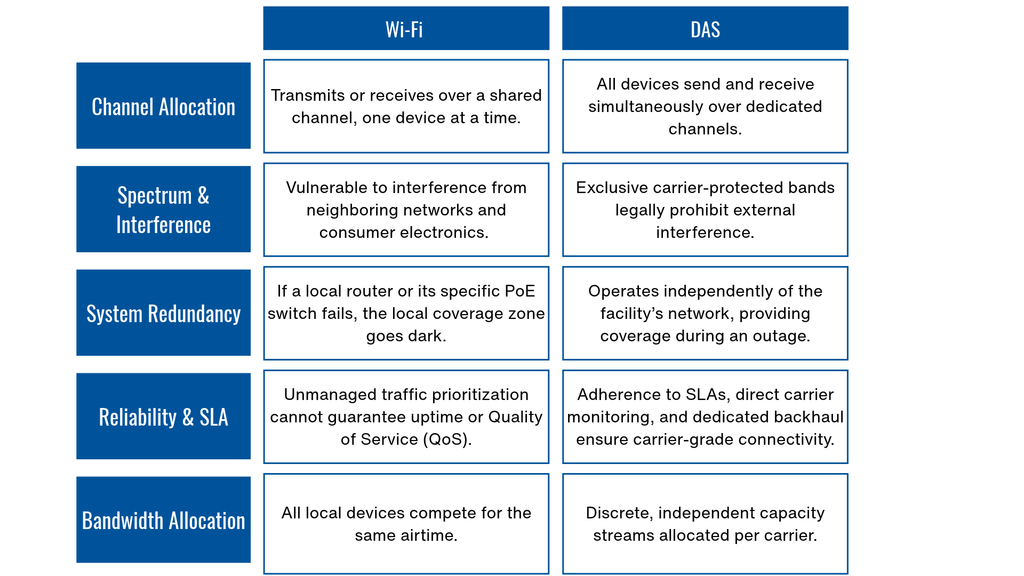
Wi-Fi vs DAS
For many, if not most, network and facility managers, the in-building wireless decision comes down to either Wi-Fi or a distributed antenna system (DAS). Both technologies offer ubiquitous indoor coverage and penetration, massive capacity, and scalability. But when system redundancy and reliability become primary objectives, clear differences between the two emerge.
SOLiD BARS Takes the DAS Advantage a Step Further

The SOLiD BARS™ DAS is specifically designed to deliver carrier-grade reliability and the lowest total cost of ownership for low-density, small- and medium-size facilities. Read more
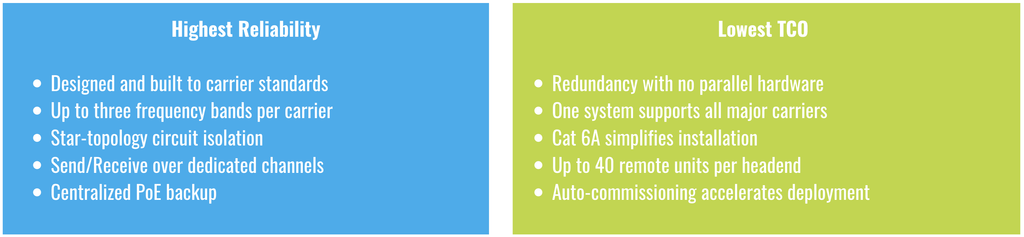
Protect Your Bottom Line with SOLiD BARS DAS
Ensuring a downsized workforce has ubiquitous, uninterrupted communication capabilities drastically reduces mean time to resolution (MTTR) during critical incidents. The financial benefits of preventing these bottlenecks are immediate:
- Resolving a network outage 15 minutes faster saves approximately $135,000 per incident.
- In a warehouse processing 10,000 daily picks, eliminating a 5-second connectivity lag caused by dead zones saves ~$59,000 per year.
- Preventing mobile disconnects saves 30 to 40 minutes of wasted worker productivity per incident. For a neocloud data center, the savings easily cover the total system cost.
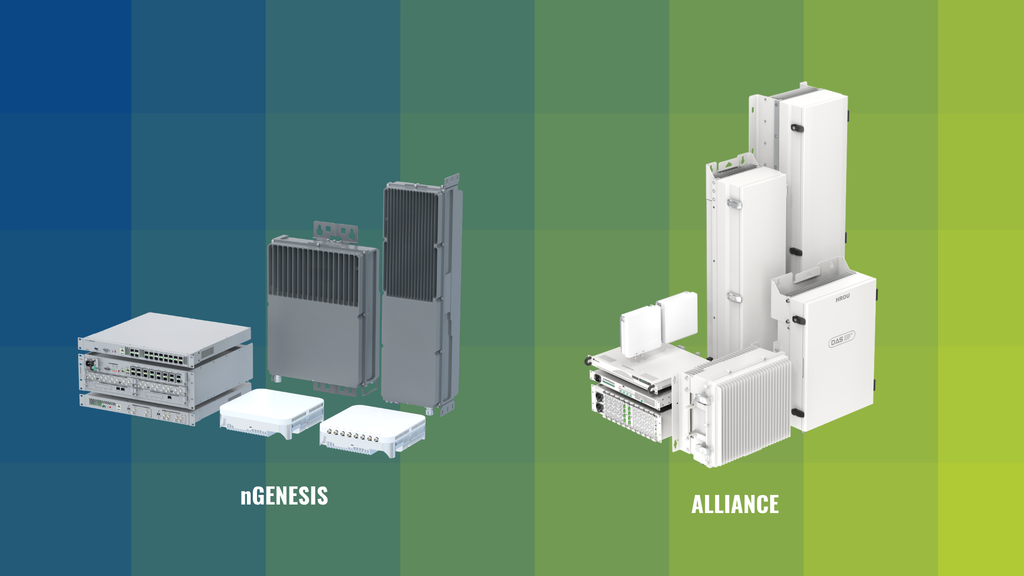
Scaling Up with nGENESIS and ALLIANCE
This core logic applies to facilities of any size, but as the footprint expands, the solution must scale to match. In regional data centers (5–20 MW) or massive hyperscale AI facilities where staff density drops as low as 0.15 to 0.20 FTE per MW, the stakes remain the same.
For these sprawling, low-density environments, SOLiD nGENESIS and SOLiD ALLIANCE platforms seamlessly extend this high-reliability cellular architecture across massive square footage. Together, SOLiD DAS solutions deliver bulletproof coverage whether your technicians are navigating a 75,000-square-foot multi-tenant data center or a multi-megawatt campus.
That’s it for this month’s edition of your SOLiD Connections newsletter. As always, we’d love to hear from you. Drop us an email or give us a call, and let’s keep the conversation going. See you next month.
This newsletter focuses on the unique challenges & benefits of a solid communications network for your building.