

Bienvenue à l’édition santé de SOLiD Connections.
L’impact de la technologie sur les soins de santé ne peut être surestimé, ni survenu à un meilleur moment. Alors que les établissements de santé cherchent à mettre en place des soins plus réactifs et personnalisés, à améliorer l’efficacité opérationnelle et à réduire le stress sur les médecins et le personnel, les technologies habilitantes existent. Des applications telles que la planification automatisée et la gestion des DSE, les moniteurs portables pour les patients à domicile et la chirurgie compatible RA/RV contribuent grandement à accroître la rapidité, la précision et la portée dont les établissements médicaux ont besoin pour améliorer leurs résultats financiers ainsi que les résultats et la satisfaction des patients. Sous la technologie se trouve un réseau sans fil intégré qui doit soutenir de façon fiable le flux massif de données et de communications. Lorsqu’il est bien fait, le réseau est plus qu’un simple facilitateur des technologies actuelles; C’est un lien vital avec la suite.
Lisez la suite pour découvrir comment faire.
L’essor de l’hôpital intelligent
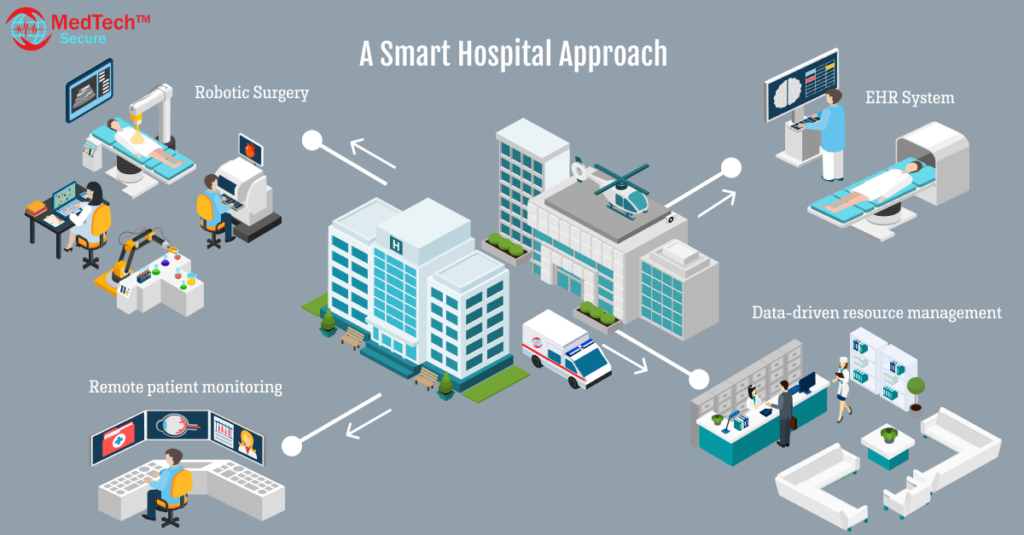
Le modèle d’hôpital intelligent intègre des applications et technologies émergentes, des stratégies basées sur les données et des solutions centrées sur le patient pour créer un écosystème de prestation de soins de santé fluide, efficace et centré sur le patient.
Une caractéristique clé d’un hôpital innovant est son interconnexion. Grâce à l’Internet des objets (IdO), les dispositifs médicaux, capteurs et équipements communiquent de manière fluide, permettant la surveillance en temps réel des patients et des actifs.
La croissance des hôpitaux intelligents s’accélère alors que les établissements de santé passent des modèles de soins traditionnels à des écosystèmes numériques axés sur les données. Selon Mordor Intelligence, le marché mondial des hôpitaux intelligents devrait atteindre environ 80,6 milliards de dollars cette année avant de plus que doubler pour atteindre 182,07 milliards en 2031.
Le rôle crucial de la connectivité sans fil
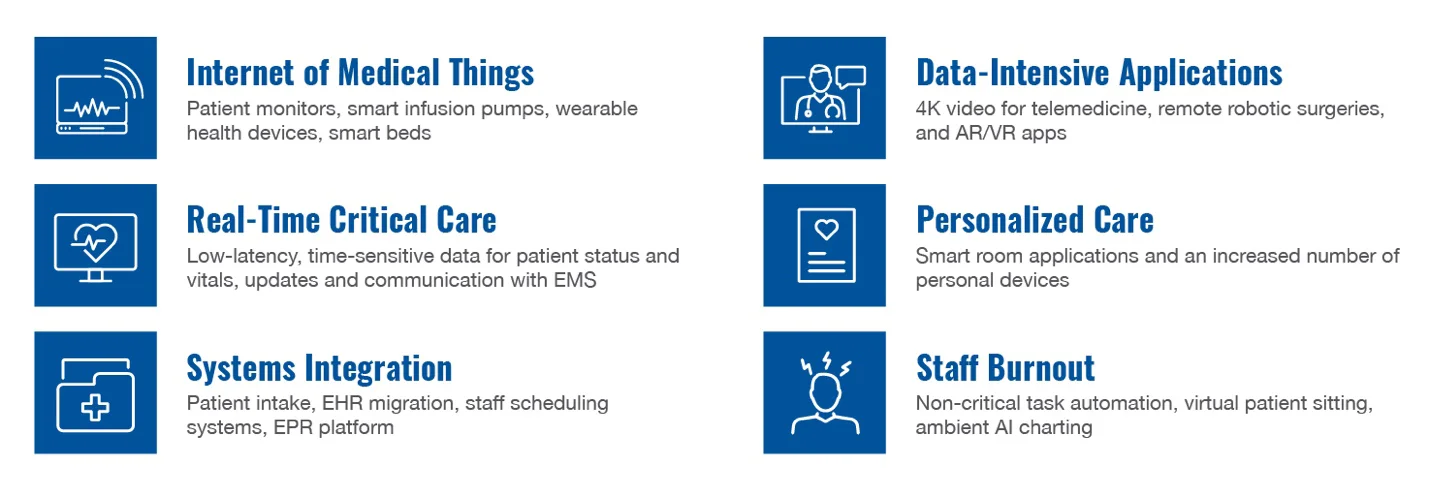
Les réseaux sans fil hospitaliers font face à des demandes intenses et croissantes, motivées par la prolifération des dispositifs médicaux IdO, la surveillance en temps réel des données et les systèmes de dossiers médicaux électroniques (DSE) basés sur le cloud. Les besoins à haute bande passante pour la télémédecine, l’imagerie et le divertissement des patients, ainsi que des exigences critiques de faible latence pour la sécurité des patients, mettent les infrastructures à rude épreuve.
Pour en savoir plus, consultez le blogue, Comment la mauvaise connectivité influence les résultats pour les patients
5 raisons pour lesquelles le DAS devrait faire partie de votre mix sans fil
- Pénétration supérieure du signal
• Un réseau d’antennes à faible puissance répartit les signaux de façon uniforme, éliminant les « zones mortes » dans les zones critiques telles que les cages d’escalier, les ascenseurs et les sous-sols.
• Les antennes sont placées plus près des utilisateurs, contournant ainsi les obstacles physiques qui bloquent souvent les signaux cellulaires. - Support multi-opérateurs, hôte neutre
• Prend en charge tous les principaux opérateurs cellulaires (par exemple, AT&T, Verizon, T-Mobile) sur une seule infrastructure.
• Permet aux patients de se connecter avec leurs proches et du contenu en ligne, ainsi que les professionnels de soins de mieux surveiller et réagir afin d’améliorer les résultats et l’expérience du patient.
• Les cliniciens offrent des soins plus précis et les résultats pour les patients s’améliorent grâce à la connectivité mobile. - Sécurité critique et conformité réglementaire
• Soutient les systèmes de communication radio des intervenants d’urgence pour assurer le fonctionnement des radios bidirectionnelles dans tout le bâtiment en cas de crise.
• L’utilisation du spectre licencié est moins sujette à la congestion et aux interférences courantes aux bandes Wi-Fi non licenciées. - Fiabilité critique pour la mission
• La liaison cellulaire directe assure une bande passante dédiée aux applications médicales et à l’accès public.
• Les données cellulaires chiffrées au niveau de l’opérateur sécurisent mieux les données sensibles des patients que le Wi-Fi classique. - Fondation pour le succès futur
• Le DAS évolue avec les nouvelles technologies pour supporter la 5G privée, le découpage de réseau et une variété de services de nouvelle génération.
Solutions SOLiD pour tout environnement de santé
En tant que fournisseur de premier plan de DAS pour les établissements de santé, SOLiD apporte plus de 25 ans de connaissances et d’expertise en DAS, ainsi que des déploiements réussis dans certains des hôpitaux les plus respectés. Notre portefeuille de solutions pour l’industrie de la santé comprend des plateformes unifiées pour les plus grandes installations, un support pour les appareils et applications en périphérie, ainsi que des solutions conçues pour les petits hôpitaux, les cliniques externes et les sites satellites.
Peu importe votre environnement de santé, nous avons une solution SOLiD DAS pour vous.
SOLiD Alliance analogique DAS : Plateforme unifiée prend en charge tous les principaux opérateurs/fréquences de sécurité publique sur un seul brin de fibre
- nBIU : Head end haute capacité offrant une capacité 2X dans 70% d’espace en moins, idéal pour les campus médicaux nécessitant une empreinte compacte et une large plage de fréquences
- edgeROU/edgeHUB : Télécommande DAS active à haute vitesse et faible latence qui prend en charge les appareils et applications basés en périphérie
SOLiD BARS : Plateforme médicale « Middleprise » pour les établissements de santé plus petits et/ou ruraux
Pour un examen plus approfondi, téléchargez notre brochure DAS Solutions for Healthcare.
C’est tout pour l’édition de ce mois-ci de votre infolettre SOLiD Connections. Comme toujours, nous serions ravis d’avoir de vos réponses. Envoyez-nous un courriel ou appelez-nous, et poursuivons la conversation. À le mois prochain.
Cette infolettre met l’accent sur les défis et avantages uniques d’un solide réseau de communication pour votre immeuble.